What is an activist?
You may have heard a lot about activism and activists on campus, in your community, and on the news. Activists are discussed in a variety of contexts, from speaking at UN Summits to creating petitions and art exhibitions, but what actually is an activist? The Cambridge Dictionary defines one as ‘a person who believes strongly in political or social change and takes part in activities such as public protests to try to make this happen’.
Protests aren’t the only option though – if you’ve ever voted on a Make A Change, made art with a message, or even stood up for someone when things seem unfair, you have taken part in activism. You don’t need any special qualifications or experience to become an activist – all you need is belief in your ideas and the motivation to get involved.
What is a campaign?
Historically, student activists have made their mark with campaigns. In How to Win Campaigns, Chris Rose describes how campaigns ‘harness a collective will and effort as an engine of change for the public benefit’. In other words, campaigns are a tool to build power by convincing other people to support your aims, enabling you to influence change at local, national, and even international level.
Successful campaigns on campus include the SU Presidents’ Buses Union Priority campaign and Stop AI FXU, which mobilised students to make a difference for the community.
Want to make change but don’t know where to start? The SU’s campaign planning resources will show you how to get started, plan tactics, and look after your wellbeing.
Getting started: what are your objectives?
The key to successful campaigns is clear, measurable objectives. Sometimes when you care about an issue it can be overwhelming and hard to know what to focus on – for example, a climate activist may not know which aspect of climate protection to focus on as it’s a multifaceted issue. To help move past this, it can be useful to answer the following prompts:
- What issue are you passionate about?
- What would a world where your issue was resolved look like?
- What is the problem that is preventing this world from existing?
- What are actionable steps that you can take to address this problem?
From here, you can take your overall campaign aim: your vision of the world where this issue no longer exists. By identifying barriers to this vision and steps you can take to resolve them, you can begin to list key campaign objectives.
Objectives dos and don'ts
The more targeted your objective is, the easier it will be to plan a successful strategy and evaluate your impact. ‘Lobby the local public transport network to reduce ticket prices by 10%’ is a more useful objective than ‘make transport more affordable’.
Always campaign for your ideal outcome. You will motivate more people if your objectives are inspiring and will make a meaningful difference to peoples’ lives. You are also more likely to get further with an ambitious objective, even if you don’t fully realise your goal.
While an objective may at first glance seem positive to you, it may have an unintended impact on people with different lived experience to you. Take time to reflect and ensure your objectives will be beneficial for the whole community and avoid marginalising others.
it is totally fair to have lots of things you care about relating to the issue you’re campaigning on (most people become activists because they care, after all!) However, if your objective is too vague or tries to cover too many things, it can be difficult to strategise and hard to measure impact. This can be demotivating and slow your work down.
Don't: look too far afield
Your campaign may well be part of an intersectional, global movement. But your work will be most effective if you are aware of your limits, focusing your energy where you are most likely to effect change. i.e. don’t start with trying to change the United Nations’ policy, but instead try influencing your local MP. Lots of activists making change in their communities has a cumulative effect, helping to change the conversation at a societal level.
Building your campaign team
Once you know what you want to change, you can find other people to join your campaign team. A campaign team not only increases your work capacity, but also brings different skillsets and perspectives to the table. Maybe someone you know is a great public speaker, or a graphic design whizz. Someone else might be a brilliant strategist. They might just be passionate about your cause and eager to learn – fantastic!
However big or small, experienced or new your campaign team is, it’s helpful to organise around the following points:
Regularly checking in, through meetings, a group chat, or other methods, is important to ensure your team are on the same page and are clear on what they’re working on.
Delegate and be democratic
There’s no point in recruiting a team if you do all the work and don’t let others have their say. Delegating different areas to team members and allowing everyone to shape the work will make your campaign more successful by ensuring no one is overloaded and giving team members ownership.
At times campaigning can be heavy, especially if you are campaigning on an issue that is close to your lived experience. Equally, it can be extremely uplifting to work towards a shared goal, and fun to connect with like-minded people. Make sure to highlight these positives, and find time between actions to have socials or opportunities to have fun. Joy is a vital defense against activist burnout, and will make your campaign more appealing to potential supporters or key campaign contacts!
Plan your strategy: a guide to issue mapping
Your campaign aims and objectives are what you want to achieve. Your campaign strategy is how you will get there – who you target and which tactics you use. The most effective strategy will consider the context of your campaign, the systems at work, and different factors that may impact motivation to act in a certain way.
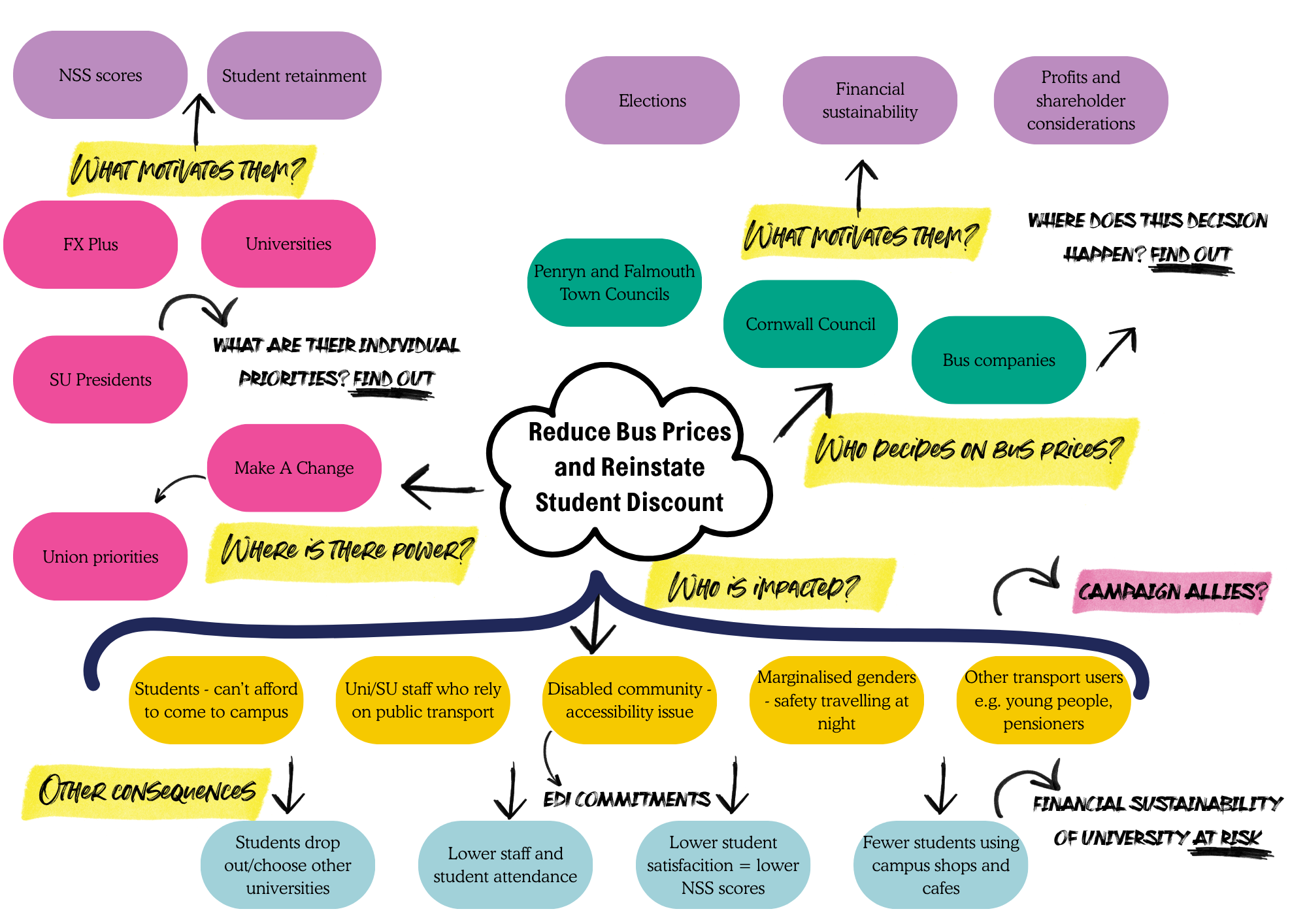
A useful exercise is creating an issue map. This involves taking your objective and the problem it is trying to fix, and mapping out all the relevant actors, systems, policies, and influences for this problem. Issue mapping can look however you want it to: If you’re a visual person it can be a diagram with lots of images and colours, or if you’re more into note taking it can be answers to a series of questions. To get you started, think about the following prompts:
- What is the objective you want to meet?
- Who makes the policy/operational decision about your objective?
- Where does this decision happen? What is the system/process for making the decision?
- How did we get to the current situation? What happened before? Where can you find this information?
- What motivates and/or concerns the people in charge of this decision?
- Who are their allies and opponents? Who are your allies and opponents?
Answering these questions should allow you to make connections between systems, people, and the decisions they make. It will also allow you to identify opportunities to influence the decisions being taken, recruit allies to your cause, and how actors are likely to respond to different tactics. This can help your team decide what you will do and where you will direct your efforts first to achieve your campaign objectives.
Here is an example issue map on the SU Presidents' buses campaign:
This resource draws on information from How To Win Campaigns: 100 Steps To Success by Chris Rose.